Book Review: “The Nichel Boys” by Colson Whitehead
Håfa adai! February is Black History Month in the United States. To honor this heritage month, I will post reviews of books across various genres written by African American authors that may retell experiences within Black history, create alternate worlds and universes, or portray Afrofuturism. My first selection of February 2026 is The Nickel Boys by Colson Whitehead.
This book review consists of two parts: a spoiler-free plot summary and my thoughts on the story. In the second part, I give my personal rating and break down the setting and worldbuilding, storytelling, cast of characters, and themes. There may be some lightweight spoilers—such as how characters interact with each other and the world around them—but I will not give away any major plot twists or endings. I want to share my opinions of the book and maybe encourage you to purchase a copy of your own.
Click on the tags at the bottom of this post to see all reviews with the same tags in the Fiction bookshelf.
Spoiler-Free Plot Summary
Elwood Curtis is a Black teenager coming of age in 1960s Tallahassee, Florida. As the Civil Rights Movement sweeps through the United States, the words of Martin Luther King Jr. inspire Elwood to pursue a higher education and fight the injustices of Jim Crow laws. His hard work and dedication pay off when he is offered the opportunity to take advanced placement university classes as a high school student! But the entire trajectory of Elwood’s life changes on what was supposed to be his first day of university when the innocent act of accepting a ride from a stranger leads to him being sentenced as a delinquent to the Nickel Academy, a reform school from which none leave unscarred.
Important Trigger Warning for The Nickel Boys
The Nickel Boys heavily depicts systemic racism, racist language, institutional abuse, physical torture, sexual violence, child abuse, and child murder. These themes are essential to the plot. If these would cause you distress or discomfort in any way, then please make sure to take necessary steps to prepare and protect yourself before and after reading this book.
My Thoughts on The Nickel Boys: 5 stars!
Colson Whitehead’s The Nickel Boys is a tragic tale of innocence lost, told along two alternating timelines: Elwood Curtis in the 1960s, and Elwood Curtis in the 2010s. In the 1960s timeline, Elwood Curtis is a studious, idealist teenager with incredible plans for the future that are completely derailed for reasons that have nothing to do with him. Once at the Nickel Academy, he becomes friends with Turner, a teen with a more cynical and realistic view of the Jim Crow world around them. In the 2010s timeline, Elwood Curtis is a married man and a business owner following the news of an archaeological investigation at the grounds of the long-closed Nickel Academy; the reported findings validating what he and many others always knew to be true.
A scene that grabbed my attention in the beginning of the story describes a set of display books that, from the perspective of someone walking past a bookshelf, would see a complete set of encyclopedias. But if that person opened any of those display books, they would see nothing but an empty shell. This served as a brilliant analogy for the Nickel Academy. To the eyes of visitors, the segregated White and Black sides of the campus would appear identical. And when people with cameras show up, the administrators and staff of the Nickel Academy reinforce this façade by supplying the Black students with fresh clothes, seemingly updated living conditions, and well-made food.
From my perspective, the choice of the Nickel Academy administrators and staff — which consists of individuals who are White and Black — to create a false front for the one day the institution is being documented is an acknowledgement of guilt, highlighting the many themes throughout the story. The first and most apparent theme of The Nickel Boys is systemic racism. As a reform school, the Nickel Academy is a juvenile penal institution for delinquent underage boys from various communities. Yet the “crimes” many of the Black students were convicted for include hitch-hiking and being out late at night. For the crime of existing in certain spaces and times, Black boys as young as 8-years-old were sent to Nickel.
Once Elwood arrives at the Nickel Academy, the second theme of the story quickly emerges. No matter the reason they are held at Nickel, and no matter how close they keep to themselves, it seems only a matter of time before every Black student must face the reform school’s institutional violence. The school administrators and staff frequently enact forms of corporal punishment on Black students that far cross the line into physical torture, going so far as to take many students “out back” for additional punishment. A trip from which some boys never return. Elwood attempts to blow the whistle on the real goings-on of the Nickel Academy, but Turner can only see that as having a horrible outcome for his friend. It is through the reinforcement of this third theme, normalized injustice, that perpetrators of systemic racism and institutional violence are emboldened to carry out their vile actions. And from the perspective of Black students like Turner, it is because of normalized injustice that he has no faith of intervention.
All that being stated, the words I would use to describe what I felt after finishing The Nickel Boys are devastated and appreciative. It is no exaggeration to say that Colson Whitehead’s storytelling left me in tears. I know that there are many who choose not to engage with the most painful and ugliest chapters of United States history. As someone who has worked in the social sciences for 15 years now, I have heard many variations of “but that was in the past, we should stop talking about it and let it go.” I understand that this sentiment is inherently ignorant and stems from an intense discomfort with hearing about such narratives, no matter what lived experience the speaker would have had if they lived during that time. So, I will repeat here my response to several of those who have made such statements to me: Is the time you spend learning about these histories — whether from a 15-minute conversation or a 400-page dissertation — more uncomfortable than the decades or centuries of human lives spent enduring these histories? Because once we normalize prioritizing minutes of our comfort over learning about the past, we are guaranteed to repeat it.
My overall rating for Colson Whitehead’s The Nickel Boys is 5 out of 5 stars. If you are looking for a story that will make you cry, this is it! Colson Whitehead’s writing teems with empathy, emotion, nuance, and directness. His storytelling throughout The Nickel Boys is a scathing indictment of systemic racism, a plea for justice for the victims and survivors of institutional violence, and a hope to amplify the voices of those who went through reform schools like the Arthur G. Dozier School for Boys, especially those left in unmarked mass graves. And the plot twist absolutely took me by surprise! I highly recommend The Nickel Boys to anyone wanting to learn more about the lived experiences of Black Americans in the Jim Crow era United States.
Dångkulo' na' saina ma'åse'! Thank you so much for reading my review of The Nickel Boys by Colson Whitehead.
Post Date: 2 February 2026
Rating Cheat Sheet
4.75 - 5.00 stars: As many people as possible should read this book!
4.00 - 4.50 stars: I appreciated many aspects of this book. I recommend it!
3.00 - 3.75 stars: I liked some aspects of this book. I will not revisit it, but someone else might really like it.
2.00 - 2.75 stars: There were some things I appreciated about this book, but I do not recommend it.
0.25 - 1.75 stars: I do not recommend this book! I did not enjoy or appreciate the experience of it!
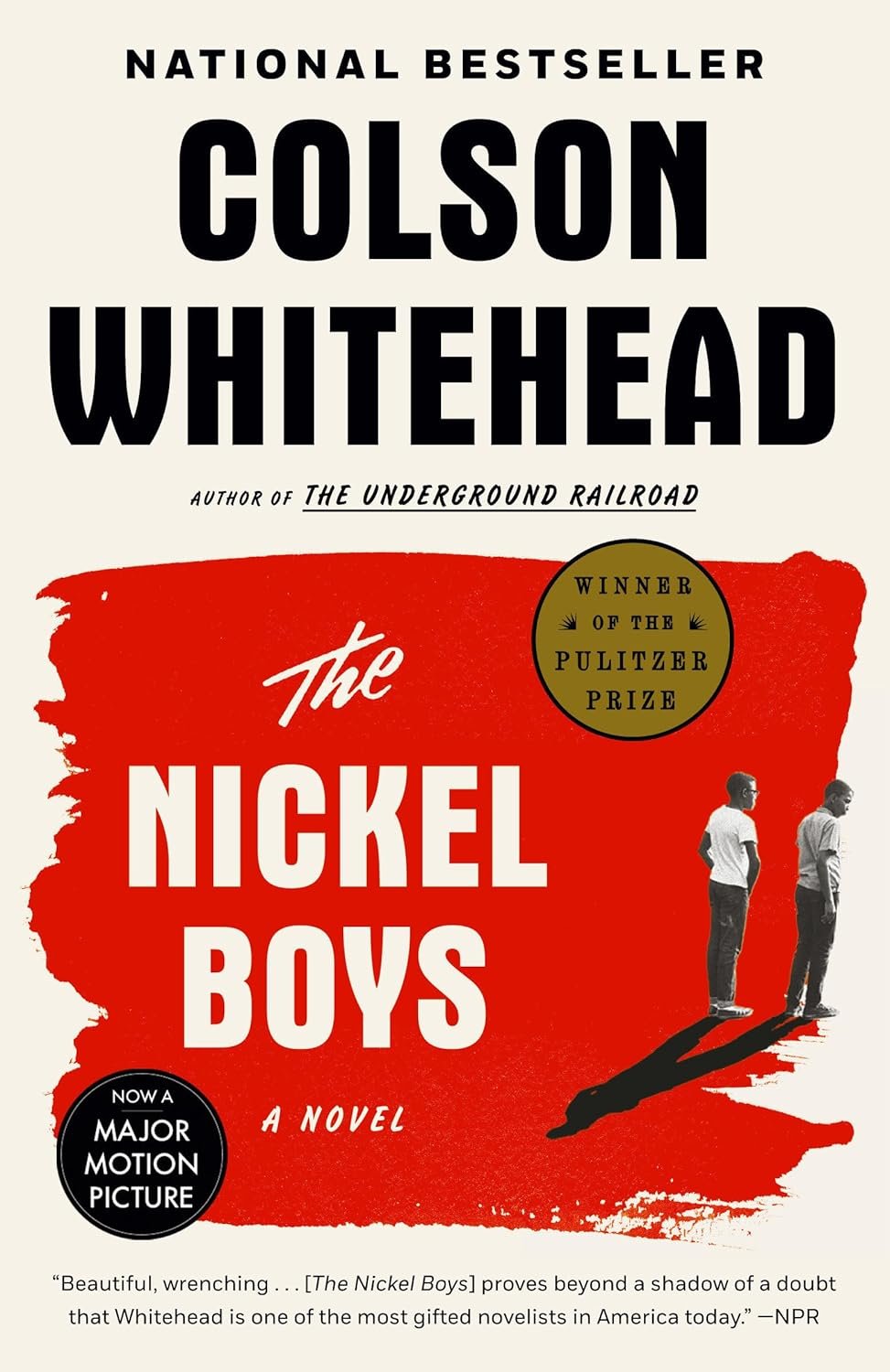
Published: 16 July 2019
Publisher: Doubleday
More Books from Colson Whitehead